Reserve

Lumium

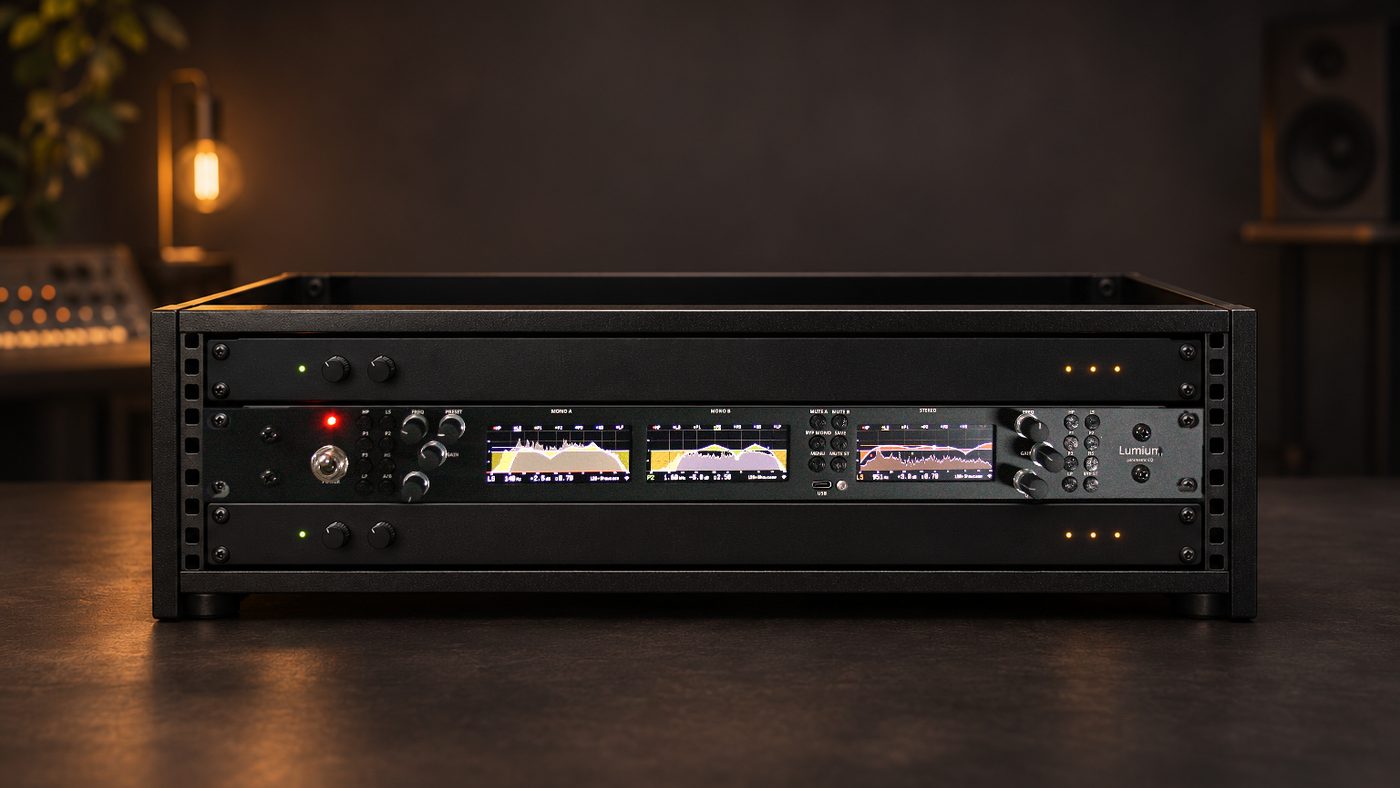
A 1U rack parametric EQ with three colour screens. Each screen draws its channel's EQ curve over a live spectrum of the signal going through it.

Lumium, a black 1U rack unit with three colour screens showing EQ curves
€649 pre-order price
planned launch price €799

Ships March to April 2027 to Ireland, the UK and the EU, shipping included. The deposit is refundable until your unit ships.

Four audio paths, seven bands each

Lumium has two mono channels and a stereo pair: four independent paths in one rack space. Every channel has seven bands: a high-pass, a low shelf, three bells that can each become a notch, a high shelf and a low-pass.

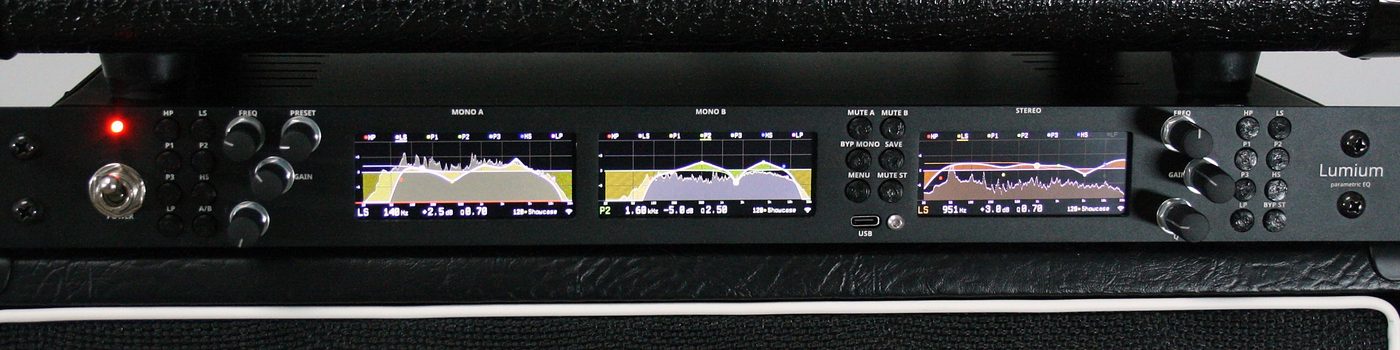
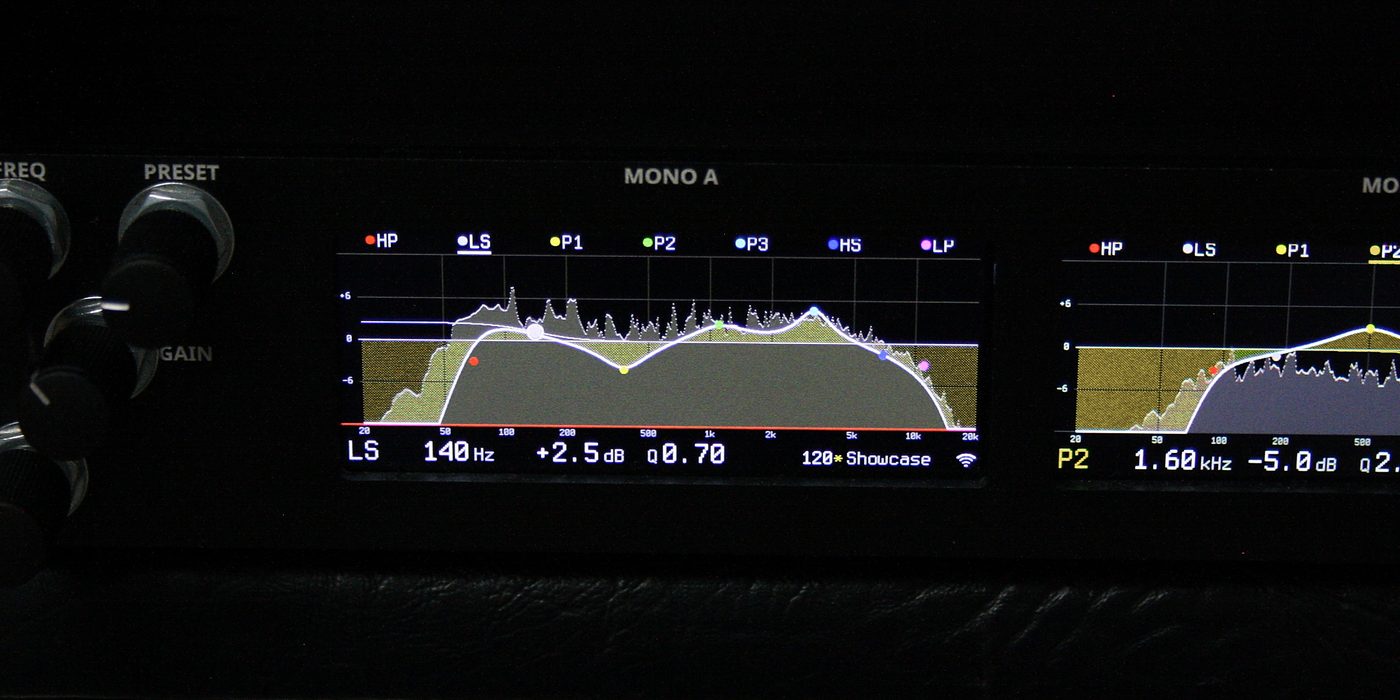
Each channel has its own screen. The curve sits on top of a live spectrum analyser, so a boom at 250 Hz shows up as a peak before you reach for a knob.

Bands
20 Hz to 20 kHz, ±24 dB, Q 0.1 to 18, slopes 6 to 48 dB/oct
Latency
1.3 ms input to output
Presets
128, recalled by MIDI program change
Bypass
Relays: bypassed or switched off, it's a straight wire
Editor
Browser editor and phone remote over USB-C, Wi-Fi or Ethernet
Close-up of the Mono A and Mono B screens: white EQ curves with coloured band handles over the live spectrum

Where it goes

The four paths are independent, so one unit can sit in several places in a rig at once. In the diagrams the yellow boxes are Lumium's channels.

Before the amp and in its effects loop

An EQ in front of the amp changes what the preamp distorts: cut the lows and it tightens up, push the mids and it drives harder. The same EQ in the effects loop shapes the distorted tone itself. Lumium does both at once, and one preset recalls both.
Two amps from one guitar or bass

A splitter feeds Mono A and Mono B, one in front of each amp. A common bass setup is a clean amp for the low end and a driven amp for the grit; each gets its own EQ here, and the stereo channel is still free.

Recording through a mic preamp

Between a flat mic preamp and your interface, Lumium EQs the sound as it's recorded. You hear the result in your headphones 1.3 ms later instead of after the DAW's monitoring buffer, with the curve and the analyser on the screen while you track.

A hardware EQ for your DAW

Send a track or a bus out of the interface, through Lumium and back in. You get knobs and a screen instead of a plugin window, and the presets keep your settings for the next session.

Live sound: the mains and two monitor mixes

One unit covers the PA's left and right on the stereo channel and two monitor mixes on the mono channels. The notches and the analyser make a feeding-back frequency easy to find and cut, from the rack or from a phone at front of house.

Keys, synths and modellers

Run a stereo synth, stage piano or amp modeller through the stereo channel to fit it to the PA. The same MIDI controller that changes your patches changes the EQ preset.

Acoustic guitar with a pickup

Piezo pickups feed back at a few predictable frequencies. Put a notch on each with the analyser as a guide and shape the rest with the shelves.

One screen per channel

Each screen shows its channel's seven bands as coloured handles on the curve, the selected band's frequency, gain and Q along the bottom, and the current preset. FREQ, GAIN and Q knobs set the band chosen with the buttons beside them: the left-hand set works on the two mono channels, the right-hand set on the stereo channel.

Lumium mounted in a black studio rack between two other rack units

Editor and phone remote

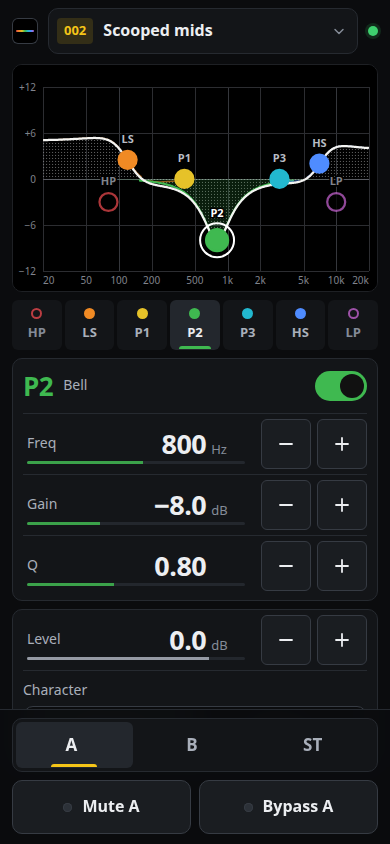
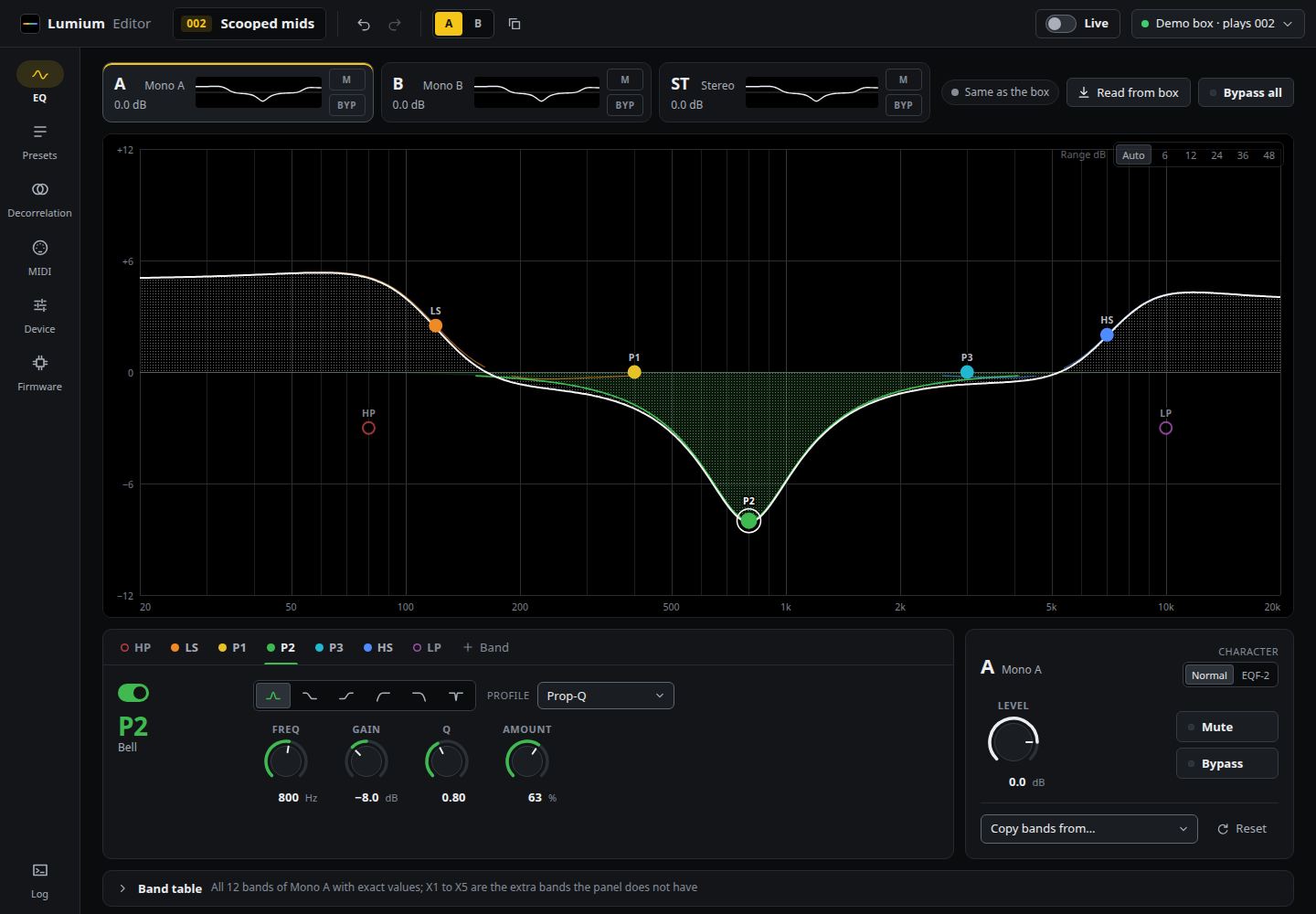
The editor runs in Chrome or Edge on a computer, over USB-C or the network. It shows the curves larger, adds five extra bands per channel, names presets and installs firmware updates. The box also serves a phone remote over Wi-Fi: open its address in the phone's browser. There's no app to install and no account.

The Lumium editor in a browser: a large EQ plot with band handles and the selected band's controls The phone remote: the curve, band buttons and plus/minus controls

Specifications

Measured on unit number one with a Keysight oscilloscope and its signal generator.

The Lumium front panel straight on: power switch, band buttons, knobs, three screens, mute and bypass buttons
Format1U, 19-inch rack
ChannelsMono A, mono B, stereo L/R: four independent paths, 4 in and 4 out
EQ7 bands per channel: high-pass, low shelf, 3 bells or notches, high shelf, low-pass · 20 Hz to 20 kHz · ±24 dB · Q 0.1 to 18 · slopes 6 to 48 dB/oct · 5 extra bands from the editor
Frequency response, flat±0.55 dB, 32 Hz to 20 kHz (−1 dB at 20 Hz)
EQ accuracyMeasured curve within 0.05 dB rms of the curve on the screen
Latency1.3 ms
Converters24-bit, 48 kHz; 32-bit floating-point processing
Inputs1/4-inch TRS, balanced or unbalanced · 1 MΩ for guitar and bass · +12 dB gain · −20 dB pad for line level
Outputs1/4-inch TRS, balanced, instrument or line level
BypassRelays, per channel, also when switched off
ScreensThree 2.9-inch IPS bar displays, 30 frames per second
Controls7 encoders, 22 buttons
ConnectionsUSB-C, Ethernet, Wi-Fi, MIDI in and thru (5-pin DIN)
Presets128, named, recalled by MIDI program change; levels, mutes and bypass on MIDI CC
Power12 V DC, adapter included
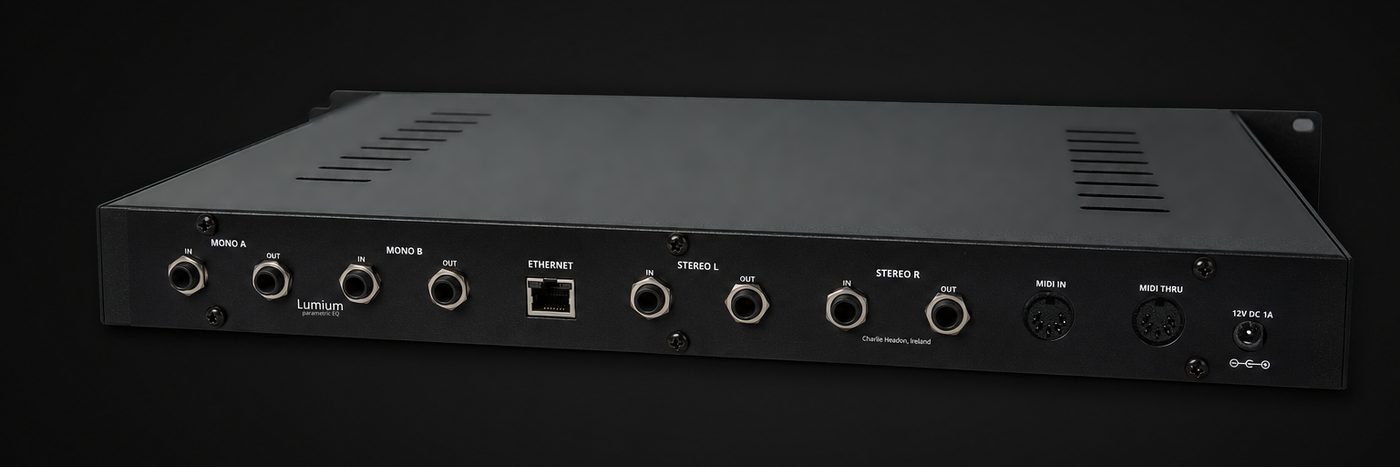
The Lumium back panel: Mono A and Mono B in and out, Ethernet, Stereo L and R in and out, MIDI in and thru, 12 V DC

Printable spec sheet

Pre-order

I build the first batch by hand in Ireland. A €50 deposit holds a unit from it at the pre-order price.

€649planned launch price €799
  • €50 now, €599 when your unit is ready to ship
  • Refundable any time until it ships, and for 14 days after it arrives
  • Ships March to April 2027, or your deposit comes back
  • Ireland, the UK and the EU. UK orders pay UK import VAT and the courier's fee on delivery
  • 2-year guarantee; 12 V adapter in the box
Reserve one for €50

No VAT charged. Card payment through Stripe. Deposit terms

Waitlist

Build updates, the demo videos, and an email when deposits open. Free.

Who builds it

I'm Charlie, an electronics engineer in Ireland. I wanted an EQ for my own rig that could sit before and after the amp, change with my MIDI controller, and show me what it was doing, so I designed one: the circuit boards, the firmware, the editor and the case.

Every unit is assembled and tested on my bench before it ships. The numbers on this page come from that bench.

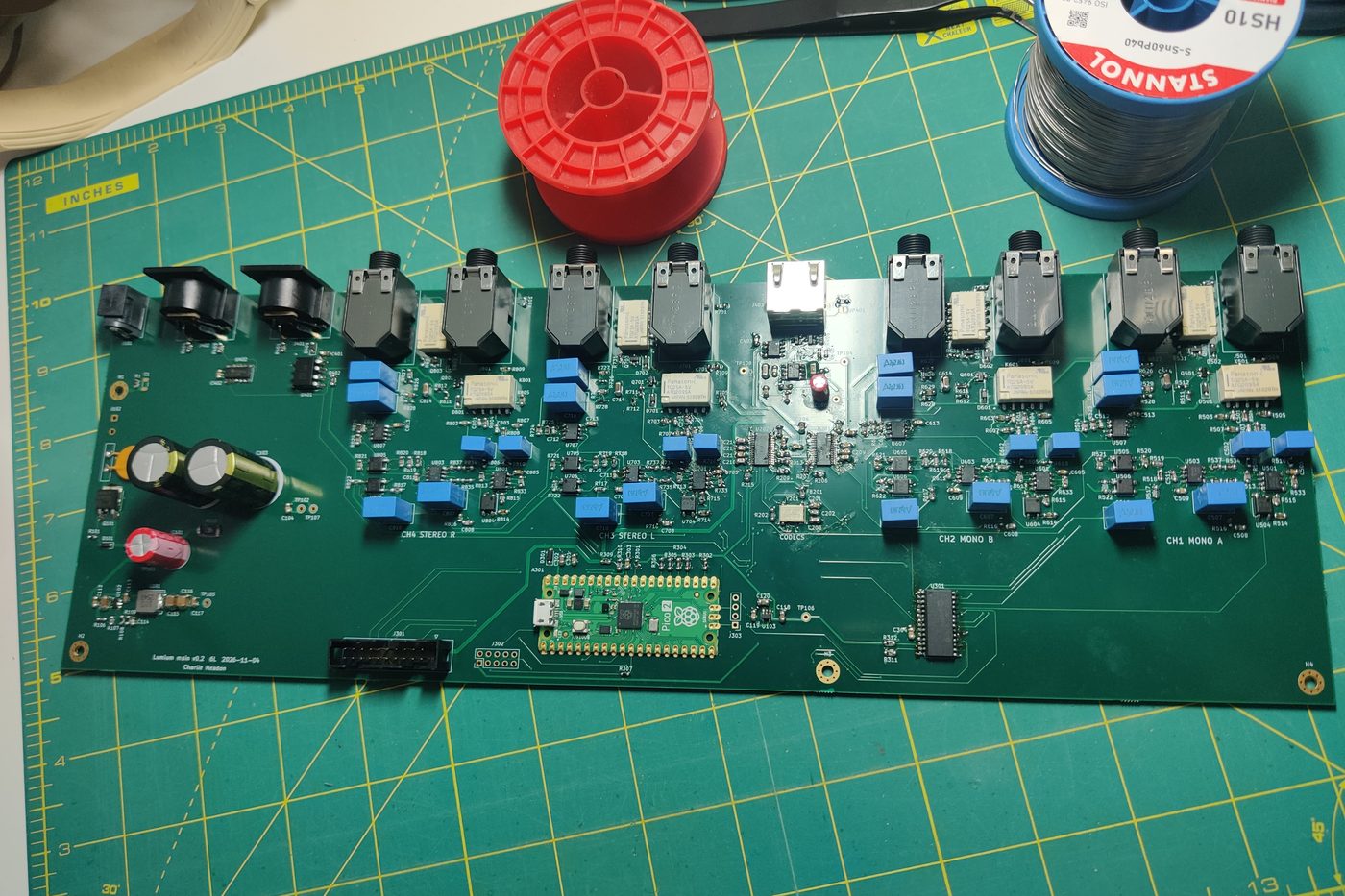
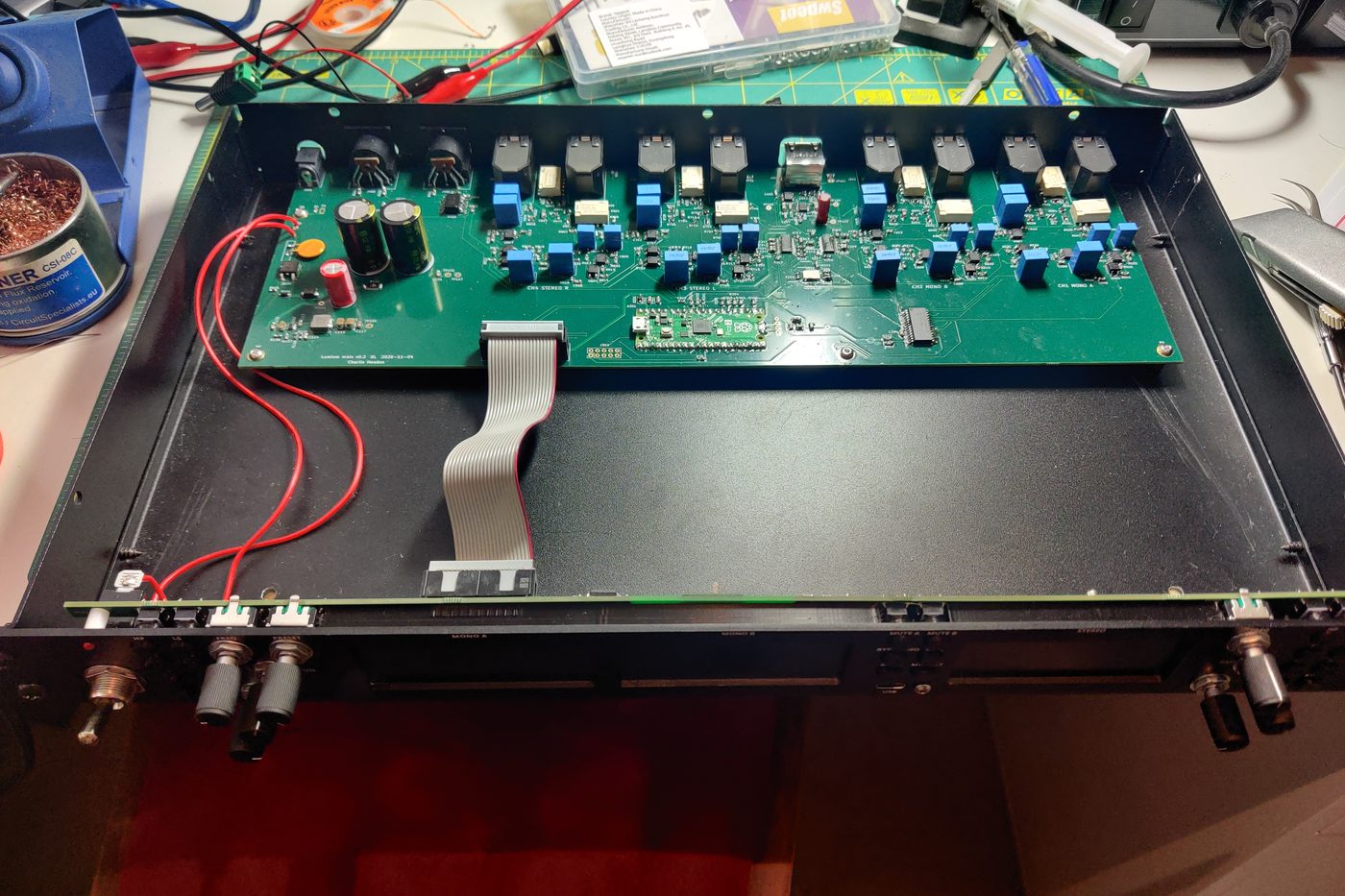
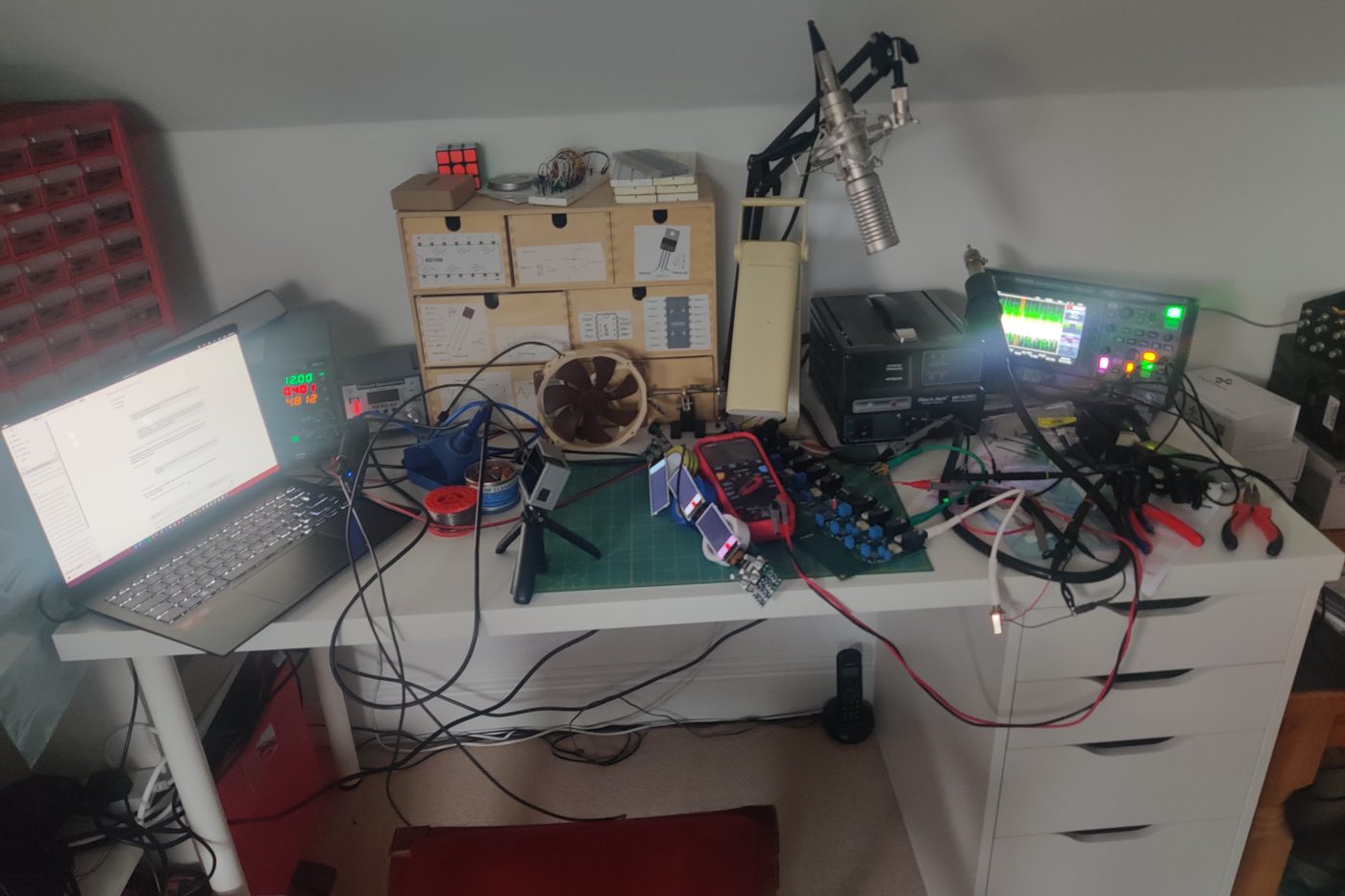
The populated Lumium main board on a cutting mat, with jacks, relays and the processor module Lumium with the lid off: the main board in the case, the ribbon cable to the front panel The bench during bring-up: laptop, oscilloscope, multimeter and the boards wired up

Questions

What happens to my €50?

It reserves a unit at €649. When yours is ready I email you for the remaining €599. If you change your mind before it ships, or I miss the delivery date, you get the €50 back. After delivery you have 14 days to return it.

When does it ship, and where to?

The first batch ships March to April 2027 to Ireland, the UK and the EU, and shipping is included in the price. UK orders come from Ireland, so UK import VAT (20 %) and the courier's handling fee are paid on delivery. Elsewhere: join the waitlist so I know where to go next.

Do I need a computer or phone to use it?

No. Everything is on the front panel. The editor and the phone remote make long sessions quicker and let you name presets.

Does it work with a modeller (Helix, Quad Cortex, Fractal, Kemper)?

Yes. Put it after the modeller's outputs on the stereo channel, or in the modeller's effects loops on the mono channels. Use the −20 dB pad for line-level outputs.

Is it balanced?

The inputs and outputs are 1/4-inch TRS jacks. The inputs take balanced or unbalanced sources; the outputs are balanced and also work into unbalanced inputs.

Does it colour the sound when it's flat?

Flat, it measures ±0.55 dB from 32 Hz to 20 kHz with 1.3 ms of latency. Bypass is a relay, so bypassed means a straight wire.

Is there a subscription or an account?

No. The editor runs in your browser and talks to the box directly over USB or your own network.